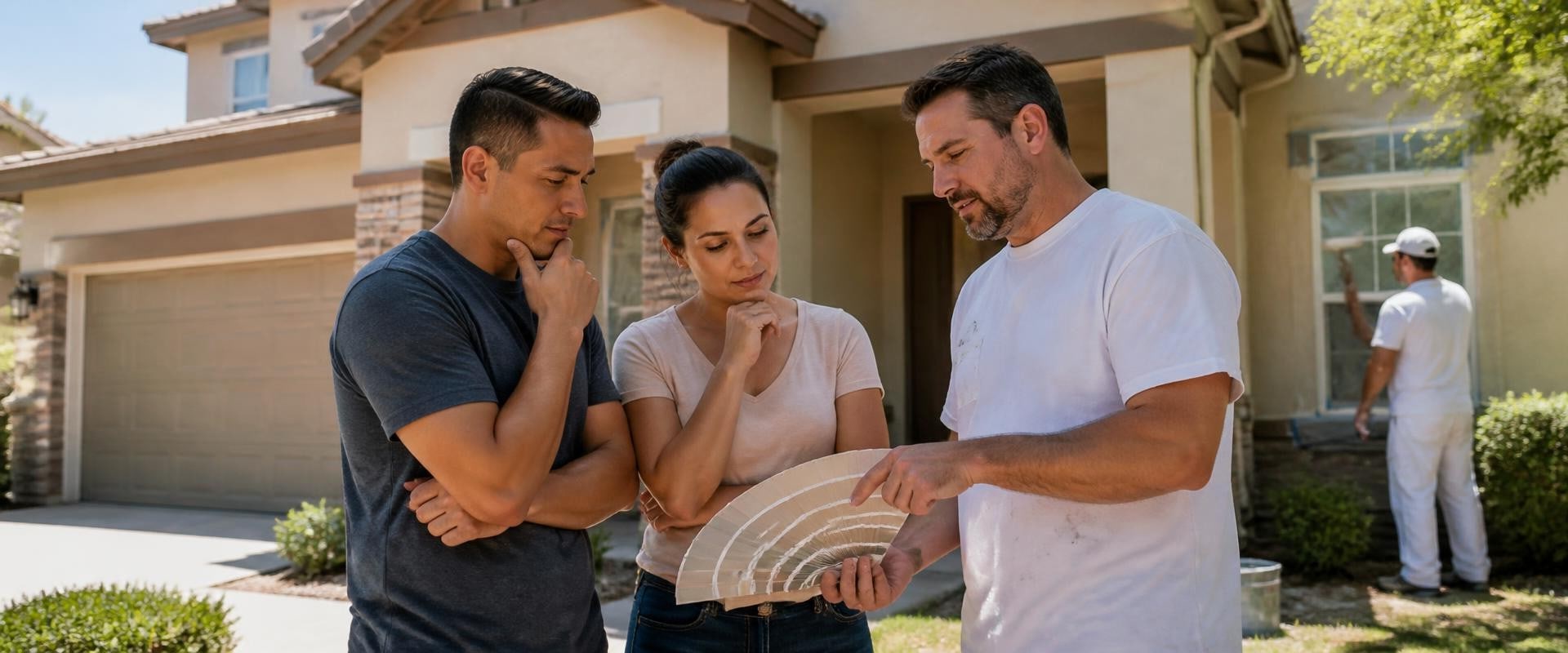
A Smarter Way to Compare Contractors, Painting Costs, andLong-Term Property Value
An evidence-informed decision framework for Goodyearhomeowners, commercial property managers, real estate investors, andconstruction professionals.
Introduction: The Most Expensive Painting Mistake May Happen Before WorkBegins
Imagine receiving three proposals to repaint a property inGoodyear, Arizona.
One contractor offers a surprisingly low price. Anotherprovides an expensive but detailed estimate. A third promises premiummaterials, excellent reviews, and a fast completion date.
Which contractor represents the best investment? The answercannot be determined from price alone.
Painting projects involve measurable differences inpreparation, materials, execution, documentation, and project management. Thesedifferences can influence immediate results, future maintenance costs, and therisk of disputes.
This guide introduces a structured method for evaluating painting contractors in Goodyear, AZ,whether the project involves a family home, rental property, commercial office,retail building, or managed residential community.
Rather than ranking local contractors without sufficientevidence, it provides a transparent decision-making framework that propertyowners can apply to their own estimates.
1. Why Painting Should Be Evaluated as a Property Investment
A painting contract is often treated as a one-time purchase.For long-term property ownership, however, it is more useful to evaluate thework as part of a maintenance investment.
The initial contract price is only one component. Otherconsiderations include surface repairs, preparation requirements, operationalinterruptions, the expected inspection schedule, and the possible expense ofcorrecting unfinished or defective work.
For example, an occupied commercial property may needpainting during restricted business hours. A residential property may requireextensive masking, minor surface repairs, or coordination with an HOA.
A detailed proposal allows these requirements to beunderstood before the project begins. The objective is not necessarily toselect the contractor charging the most. It is to identify which proposaldelivers the most appropriate scope at a defensible total cost.
2. The Goodyear Painting Contractor Scorecard
The following 100-point scoring framework is an originaleditorial assessment tool designed for comparing proposals. It is not agovernment-approved certification or a statistically validated predictor ofcontractor performance.
| Evaluation category | Maximum points |
| License, insurance, and business verification | 20 |
| Surface preparation and coating specifications | 25 |
| Comparable project experience and reviews | 15 |
| Written scope and pricing transparency | 15 |
| Scheduling, safety, and property protection | 15 |
| Warranty documentation and final inspection | 10 |
| TOTAL | 100 |
Each category should be scored based on documentation ratherthan verbal assurances.
For instance, a contractor offering detailed preparationspecifications might receive a higher preparation score than one whose proposalsimply states “prepare surfaces as needed.”
Likewise, a contractor presenting relevant commercialreferences may be better positioned for a complicated occupied-building projectthan one whose portfolio contains exclusively small residential jobs.
The scorecard is intended to improve comparisons. It doesnot replace legal compliance checks or professional judgment.
3. Verification Comes Before Contractor Rankings
Before evaluating price or presentation, confirm that thecontractor is legally qualified for the proposed work.
The Arizona Registrar of Contractors recommendschecking license records, obtaining references, requesting written estimatesfrom at least three contractors, and making sure project details appear in thecontract.
Arizona also distinguishes residential, commercial, and dualcontractor classifications. A contractor’s license should match the work beingperformed.
Owners can consult the Arizona ROC Contractor Search to reviewlicense information.
Advertising that a company is “licensed, bonded, andinsured” should not be accepted as independent verification. The ROC explainsthat insurance requirements are not identical to licensing and bondingrequirements.
For any significant painting investment, request appropriateinsurance documentation directly and verify coverage relevant to the project.
4. Comparing Painting Estimates Without Being Misled by Price
Assume three contractors submit proposals for the sameexterior repaint. The following figures are hypothetical and exist solely todemonstrate comparison methods.
| Proposal | Example price | Preparation details |
| Contractor A | $6,500 | Limited documentation |
| Contractor B | $7,800 | Defined repairs, primer, and finish system |
| Contractor C | $8,400 | Defined preparation and enhanced coordination |
Selecting Contractor A could appear to save $1,300 comparedwith Contractor B. But if Contractor A excludes work that becomes necessarylater, the true project costs may differ.
Suppose Contractor A subsequently requires $1,900 inapproved additional repairs. Its hypothetical revised total becomes $8,400.Contractor B would then cost $600 less, assuming its original scope alreadyincluded those repairs.
This example demonstrates why exclusions and change-orderprovisions deserve close attention. It does not establish that higher-pricedpainting contractors deliver better workmanship.
What Every Painting Estimate Should Explain
A useful estimate identifies the surfaces included,preparation activities, coating products, primer requirements, applicationdetails, site protection, cleanup, timeline assumptions, and warrantyexclusions.
For commercial properties, it should also define accessarrangements, work phases, equipment needs, and tenant or employeecoordination. Written details reduce the likelihood that two parties interpretthe same agreement differently.
5. Residential Projects: What Goodyear Homeowners Should Prioritize
Residential painting decisions often combine appearance,property maintenance, convenience, and budget. However, different projectsrequire different priorities.
A homeowner repainting occupied interior rooms may valuefurniture protection, low-disruption scheduling, and clear room-by-roomcompletion procedures.
An exterior repaint may involve questions about stuccorepairs, coatings, fascia condition, and protection of nearby landscaping. Arental property owner may prioritize predictable turnover scheduling andstandardized finishes.
Homeowners considering professional residential painting services should askprospective contractors how the scope will be documented and reviewed beforework begins.
The right proposal depends on the actual property, not ageneric package marketed to every home.
6. Commercial Painting: Measure the Cost of Disruption
Commercial painting should be assessed partly as anoperational project. A retail store, medical office, apartment complex, andwarehouse can have very different access and scheduling requirements.
A business may need certain entrances to remain open.Employees might require temporary alternative routes. Managers may need advancenotice before work begins. These responsibilities can affect projectsequencing.
An appropriately planned commercial painting project should address whocommunicates with occupants, how work zones are protected, and which activitiesrequire restricted access.
Consider a hypothetical office repaint in which a contractorcan either close an area for several consecutive days or complete the projectin smaller phases.
The phased option may cost more in labor or coordination butcould reduce interruption to business operations. Neither approach isautomatically superior. Owners should evaluate direct painting costs alongsideany measurable business impact.
7. How to Read Contractor Reviews Like an Investigator
Online reviews are useful when they contain specific andrelevant information. Rather than focusing exclusively on average ratings,review the underlying customer descriptions.
A useful review may explain whether the contractor followedthe written scope, communicated delays, protected the property, and resolvedconcerns.
· Projectsimilarity: Does the customer describe work comparable to yours?
· Workmanshipdetails: Does the review discuss preparation, masking, coating application,or finishing?
· Communication:Were changes and delays explained clearly?
· Problemresolution: If something went wrong, how did the business respond?
· Recency:Does the review describe the company’s more recent operations?
Reviews without detail are not automatically false, but theyprovide less evidence. Property owners should also verify that projectphotographs and testimonials belong to the business being evaluated.
For major commercial painting projects, direct referencesfrom comparable facilities may be more useful than generic online testimonials.
8. Goodyear Permit and HOA Considerations
Not every painting project involves the same approvalrequirements.
The City of Goodyear’s homeowner information pagestates that ordinary painting does not require a permit when it does notinvolve relocating electrical, mechanical, or plumbing systems.
However, painting associated with other modifications mayneed separate review. The city also instructs property owners to reviewapplicable homeowners association covenants, conditions, and restrictions.
That distinction matters because HOA approval and municipalpermitting are separate processes. An exterior color change could requirecommunity architectural approval even where routine painting itself does notrequire a building permit.
When the work involves substantial repairs or alterations,consult the Goodyear Development Center before beginning.
9. A Five-Stage Painting Quality Control Process
Stage 1: Property Documentation
Record visible surface defects, existing paint conditions,moisture concerns, and areas excluded from the scope. Photographs help clarifythe starting condition.
Stage 2: Preparation Approval
Confirm that the specified cleaning, repairs, masking, andprimer work has been completed appropriately.
Stage 3: Coating Application
Verify that the selected coating system is suitable for thesubstrate and is being applied according to manufacturer requirements.
Stage 4: Progress Inspection
Review completed sections before moving to the next phase,particularly for multi-building commercial projects.
Stage 5: Final Walkthrough
Document required touch-ups, cleanup issues, incompleteareas, and any agreed corrections.
The purpose of these stages is to make expectations visibleand reduce misunderstandings.
10. Measuring Total Painting Value Over Time
Initial price and expected service life can be consideredtogether when evaluating maintenance decisions.
Annualized projectcost = Total project cost ÷ Years in service
For illustration, suppose one hypothetical coating projectcosts $8,000 and remains satisfactory for eight years. Its annualized costwould be $1,000.
Another hypothetical project costing $9,000 and remainingsatisfactory for ten years would have an annualized cost of $900.
These calculations demonstrate the method, not predictedpainting lifespans. Actual repainting intervals vary by exposure, preparation,materials, substrate condition, and maintenance.
Future costs, discount rates, repairs, and businessdisruption may also matter in a complete lifecycle analysis. A warranty shouldnot be treated as proof that a coating will last for a guaranteed period.
11. Turning Property Inspections Into a Maintenance System
Residential and commercial owners can benefit frommaintaining simple painting records.
A useful property maintenance record contains the date ofwork, contractor, coating system, surfaces painted, project photographs, andwarranty documents.
During subsequent inspections, record any peeling, staining,damage, corrosion, cracking, or other deterioration.
Commercial managers can organize these records by building,elevation, floor, or maintenance zone.
The result is a history that helps distinguish recurringproblem areas from isolated damage. It can also improve future bidding bygiving contractors clearer information about what was previously installed.
12. Goodyear’s Growth and the Importance of Professional PropertyMaintenance
Goodyear’s development environment includes residentialneighborhoods, business facilities, and commercial growth.
The Arizona Commerce Authority’s Goodyear community profileprovides economic and demographic information useful for understanding thelocal market.
The City of Goodyear Development Services Departmentalso provides resources on construction, development, and building regulations.
These sources offer context for property owners planningrenovations, tenant improvements, and ongoing facility maintenance.
However, local development activity should not beinterpreted as proof that painting prices or demand are increasing withoutsupporting transaction-level evidence.
For contractors and property managers, an actionableopportunity is to improve documentation, scheduling, and maintenancecoordination as building portfolios evolve.
13. What Makes a Painting Company Worth Shortlisting?
A trustworthy selection process combines independentverification and project-specific evidence.
Property owners should look for clearly documentedproposals, appropriate licensing, relevant experience, references, transparentpricing, practical scheduling, and understandable warranty terms.
For those evaluating Arizona painting companies, The Paint Kingsprovides residential, commercial, and multifamily painting services through itsTucson and Chandler operations.
Its Phoenix metropolitan painting service pagedescribes residential and commercial capabilities, while the company’s projectgallery provides examples of completed work.
Goodyear property owners interested in its services shouldconfirm that their specific location and project type can be accommodated.
A project-specific discussion is more useful than assumingevery contractor covers every community within the metropolitan area.
Conclusion: Choose Evidence Over Advertising
The best painting investment is not necessarily the lowestestimate, the highest online rating, or the most expensive coating.
A better decision considers contractor credentials,documented preparation, comparable experience, written obligations, projectcoordination, and long-term maintenance requirements.
For Goodyear property owners, the 100-point scorecardprovides a repeatable way to evaluate these factors. For commercial operators,it also provides a starting point for discussing operational disruption andquality control.
A contractor who can clearly explain the work, document thescope, and respond to project-specific questions gives the owner a strongerfoundation for making an informed decision.
Reference Sources
· Arizona Registrar of Contractors: Before You Hire
· Arizona ROC Contractor Search
· ArizonaContractor License Classifications
· City of Goodyear Homeowner Information
· City of Goodyear Development Services
· ArizonaCommerce Authority: Goodyear Community Profile
Research disclosure: The contractor scorecard is an originaleditorial framework. Financial comparisons are illustrative, not actualGoodyear contractor quotations or documented project outcomes. No independentcustomer survey or experimental durability study is claimed.